
Effective leadership isn’t about applying the same strategy to every person—it’s about recognizing where someone is and walking with them accordingly. Just as a good teacher adjusts for different learning stages, great leaders adapt to the maturity and readiness of those they lead. Today, we’re going to explore how understanding maturity levels helps us lead with wisdom, clarity, and impact.
Situational Leadership, a model developed by Ken Blanchard and Paul Hersey, which emphasizes adjusting leadership style according to the maturity (or development) level of the subordinate. The core principle is:
“There is no one best way to lead. Effective leadership is task-relevant, and the most successful leaders are those who adapt their style to the maturity of the individual or group they are attempting to lead.”
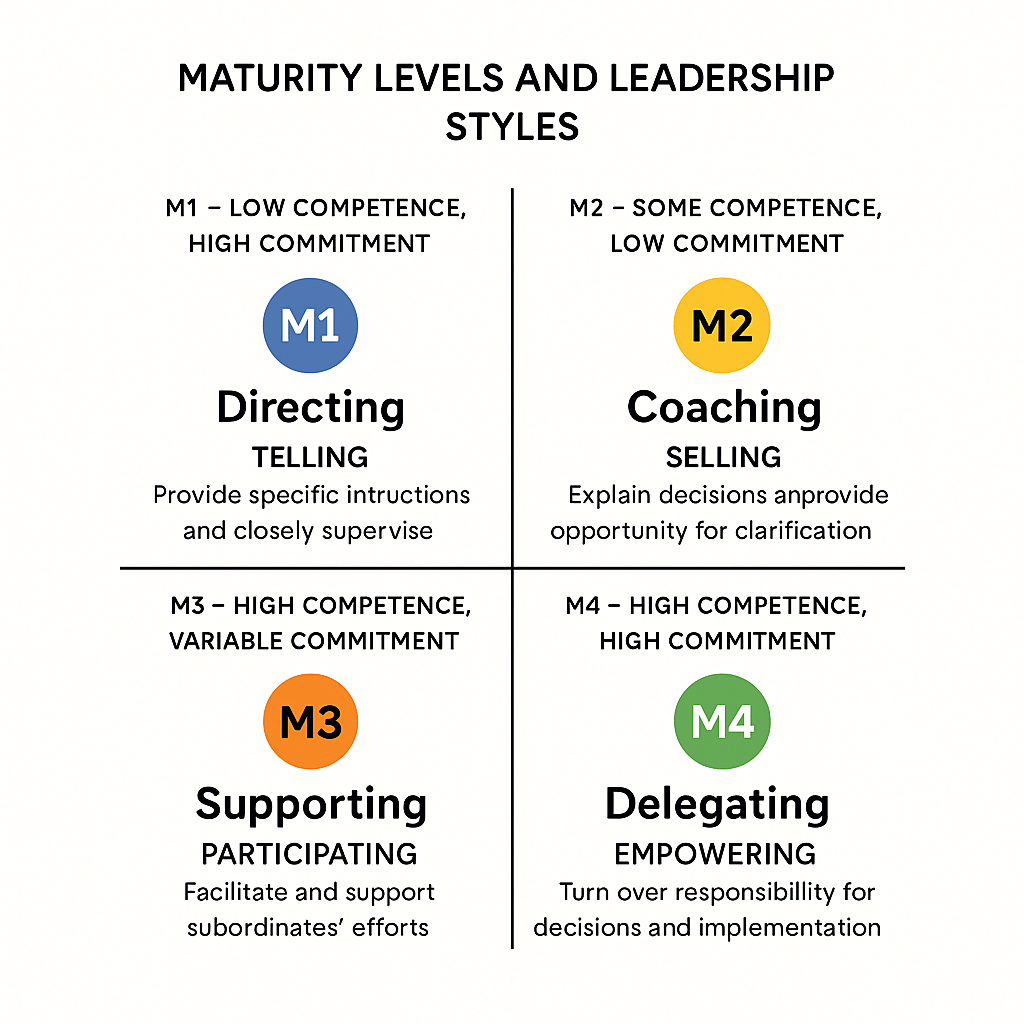
Let’s explore the four levels of maturity (often labeled M1 to M4) and how leaders should adjust their behavior accordingly
M1 – Low Competence, High Commitment
The Enthusiastic Beginner
At this stage, the individual is eager, optimistic, and willing—but lacks the knowledge, skills, or experience to perform the task effectively. They are typically new to a role, responsibility, or environment, and while their heart is in the right place, they are not yet equipped for the challenges ahead.
“People go through predictable stages of development when they learn something new. The leader’s job is to recognize where they are and respond appropriately.” — Ken Blanchard
- Motivation is driven by excitement, not competence.
- Mistakes are likely without close guidance.
- They don’t yet know what they don’t know.
This stage often shows up in new employees, first-time volunteers, or team members assigned to unfamiliar projects.
Leader’s Response: Directing (Telling Style)
The appropriate leadership style here is high-direction, low-support. The leader acts more like a teacher and taskmaster, not a collaborator.
“The leader provides specific instructions and closely supervises task accomplishment.” — Hersey & Blanchard, Situational Leadership
What This Looks Like in Practice:
- Set clear goals and expectations.
- Provide step-by-step instructions.
- Use checklists, standard procedures, and clear metrics.
- Monitor progress closely and correct mistakes quickly.
- Give immediate feedback on performance.
The focus is on the task, not the relationship. At this stage, too much freedom or collaboration can lead to confusion or failure.
Why This Approach Is Necessary: At this stage, they need clarity, structure, and direction more than encouragement. At the M1 level:
- They don’t yet know how to do the job well.
- They need structure and clarity, not autonomy.
- Motivation is high, but without direction, it can quickly turn into frustration.
This is about establishing competence through guided practice and building a foundation ofconfidence through early wins.
“When people are at the beginner level, they don’t need a coach—they need a director.” — Ken Blanchard
Practical Applications
- In the Workplace:
A newly hired employee should not be expected to “figure it out.” Instead, the leader should walk them through onboarding, assign a mentor, and provide a clear daily plan. - In Ministry Teams:
A new church volunteer should be told exactly what to do: “Arrive at 8:00 AM, check in with the coordinator, and help set up the welcome table with these items.” - In Education or Training:
A student learning a new system (like editing video or managing a database) needs tutorials, clear instructions, and close supervision—not open-ended projects. - For Parents or Coaches:
A child learning to ride a bike doesn’t need theory—they need someone holding the seat and giving direct feedback: “Pedal faster. Keep your eyes up. Balance your body.”
M2 – Some Competence, Low Commitment
The Disillusioned Learner
At this stage, the individual has gained some skill or understanding but is beginning to realize the task is more difficult than expected. Their initial enthusiasm has been dampened by reality. As a result, motivation decreases, and confidence may falter.
“People move from being enthusiastic beginners to disillusioned learners when they discover that competence takes time, and success doesn’t come as quickly as they expected.” — Ken Blanchard
- Performance is inconsistent.
- They may doubt their ability or question whether it’s worth the effort.
- Risk of discouragement, disengagement, or even giving up is high.
This is the most emotionally vulnerable stage, and how a leader responds here is critical for retention and growth.
Leader’s Response: Coaching (Selling Style)
At this stage, the leader needs to provide both high direction and high support. That means continuing to guide the task, while now investing more in motivation, encouragement, and emotional support.
“The leader continues to direct and closely supervise task accomplishment—but also explains decisions, solicits suggestions, and supports progress.” — Hersey & Blanchard, Situational Leadership
What This Looks Like in Practice:
- Offer clarity on the process, but also take time to explain the “why”.
- Encourage two-way communication.
- Acknowledge difficulties and celebrate small progress.
- Reinforce their value and potential.
- Provide constructive feedback, but wrap it in affirmation and empathy.
The leader must be both a trainer and a cheerleader at this stage.
Why This Approach Is Necessary: At M2, the task is no longer exciting—it’s hard. They are aware of their limitations, and without strong leadership, they might give up. They need:
- Confidence boosters more than just technical instruction.
- Encouragement that mistakes are part of learning.
- Reminders that they are not alone in the process.
Neglect at this stage can cause high turnover or disengagement.
“People don’t care how much you know until they know how much you care.”
— Ken Blanchard
Practical Applications
- In the Workplace:
A new employee who starts missing deadlines may not be lazy—they may be overwhelmed. Take time to review their workload, coach them through bottlenecks, and affirm their growth. - In Ministry Teams:
A volunteer who begins to back out may be afraid of failing. A leader can say: “I know it’s challenging, but I’ve seen how much you’ve grown. Let’s walk through it together.” - In Education or Training:
A student who was once eager might now express frustration. A wise teacher says: “It’s okay to struggle here—this is the point where learning deepens. You’re not alone.” - For Parents or Coaches:
When a child or athlete hits a performance wall, encouragement is essential: “You’ve improved so much already. Let’s break this down and work on it step by step.”
M3 – High Competence, Variable Commitment
The Capable but Cautious Performer
This person has developed strong skills and is competent, but their commitment or confidence fluctuates. They know how to do the task, but they may hesitate to own it fully or perform with consistency. At times, they may still seek affirmation, hesitate to lead, or second-guess themselves.
“This is the stage where leaders often get confused, because the person looks capable—but still holds back. The issue is no longer ability—it’s confidence or motivation.” — Ken Blanchard
- They are technically ready, but emotionally hesitant.
- They may resist greater responsibility due to fear of failure, lack of trust, or burnout.
- They need a leader who believes in them—and encourages them to believe in themselves.
Leader’s Response: Supporting (Participating Style)
The leader now reduces direction but increases emotional support and relational empowerment. Instead of telling or teaching, the leader shifts to listening, encouraging, and coaching confidence.
“The leader facilitates and supports the subordinate’s efforts toward task accomplishment and shares responsibility for decision-making.”
— Hersey & Blanchard, Situational Leadership
What This Looks Like in Practice:
- Invite them into shared problem-solving.
- Ask for their input and ideas.
- Offer encouragement, not instruction.
- Recognize and affirm past success.
- Express trust in their capacity.
The goal is not to push harder—but to draw out ownership and strengthen commitment.
Why This Approach Is Necessary: At the M3 level, a leader’s task is to build trust and transfer ownership. They don’t need to be managed—they need to be believed in. Without the right kind of support, capable people may:
- Plateau in performance.
- Avoid taking initiative.
- Silently struggle with insecurity or perfectionism.
This stage is a key moment to cultivate leaders, not just followers.
“You can’t push people up a ladder unless they are willing to climb.”
— Paul Hersey
Practical Applications
- In the Workplace:
A senior team member may deliver excellent work but still defer decisions. A wise leader asks, “What do you think we should do here?”—then affirms and supports the choice. - In Ministry Teams:
A volunteer who has served for years might hesitate to lead a new initiative. The leader can say: “You’ve done this before. I fully trust your judgment—run with it.” - In Education or Training:
A skilled student might doubt themselves before a big presentation. Instead of more practice drills, the teacher says: “You’re ready. You’ve prepared. I believe in you.” - For Parents or Coaches:
A child who can ride without training wheels still asks for a hand. Instead of holding the seat, the parent says: “You’ve got this. I’ll walk beside you—but you’re in control.”
Biblical Reflection: Jesus modeled this when He gradually gave the disciples greater responsibility. At first, He sent them two by two (Mark 6:7), then later entrusted them to lead the early church. When Peter failed, Jesus didn’t demote him—instead, He restored his calling and said, “Feed My sheep” (John 21:15–17).
This is the essence of M3 leadership: encourage, trust, and empower capable individuals to take their next step with confidence.
M4 – High Competence, High Commitment
The Self-Reliant Achiever
This person is fully competent, highly confident, and intrinsically motivated. They know what needs to be done and consistently deliver excellent results with minimal supervision. They take initiative, solve problems, and take full ownership of their tasks or responsibilities.
“At this stage, the individual is a peak performer—competent, committed, and confident. The best thing a leader can do is get out of the way, but stay available.” — Ken Blanchard
- They thrive on autonomy and trust.
- They are often a source of energy and motivation to others.
- Over-management can demotivate them or feel like micromanagement.
Leader’s Response: Delegating
The appropriate leadership style is low direction and low support. The leader gives maximum autonomy while maintaining availability for consultation or alignment. This is not neglect—it is intentional empowerment.
“The leader turns over responsibility for decision-making and problem-solving to the individual.” — Hersey & Blanchard, Situational Leadership
What This Looks Like in Practice:
- Assign outcomes, not methods.
- Invite them into strategic leadership conversations.
- Offer recognition, not regulation.
- Provide resources, not restrictions.
- Challenge them with larger goals and opportunities for mentorship.
Why This Approach Is Necessary: M4s are multiplier leaders.
When trusted, they:
- Perform at a high level independently.
- Develop others around them.
- Take initiative on innovation and improvement.
Over-supervising or second-guessing them can lead to demotivation or even loss of top talent. The leader’s role now becomes one of vision-casting, recognition, and strategic alignment—not control.
“People with high competence and commitment don’t need to be managed—they need to be trusted.” — Ken Blanchard
Practical Applications
- In the Workplace:
A senior manager who consistently hits goals can be given full autonomy over a project: “Here’s the vision. I trust you to get us there—let me know what you need.” - In Ministry Teams:
A long-time youth leader is given full charge of a retreat: “You’ve done this so well. Lead it your way. I’ll back you up and help remove any roadblocks.” - In Education or Training:
An advanced student can be assigned to mentor others or lead a group project with minimal oversight: “Take the lead. Your experience will lift the team.” - For Parents or Coaches:
A young adult preparing to leave home should be trusted with decisions and celebrated for growth: “You’ve grown into someone I trust deeply. I’m always here—but I believe in your choices.”
Biblical Reflection
Jesus exemplified this approach in Matthew 28:18–20 when He gave the Great Commission. After years of teaching, correcting, and empowering, He said: “Go therefore and make disciples of all nations…” He delegated His mission to His disciples—not because He was absent, but because they were ready. He empowered them fully, promising, “I am with you always”—offering presence, not micromanagement.
“The things you have heard me say… entrust to reliable people who will also be qualified to teach others.”— 2 Timothy 2:2
M4 leadership is about multiplication, trust, and release. It’s the kind of leadership that reproduces leaders, not just followers.
Summary Table
| Maturity Level | Description | Leadership Style | Focus |
|---|---|---|---|
| M1 | Low skill, high enthusiasm | Directing (Telling) | High direction, low support |
| M2 | Some skill, low confidence | Coaching (Selling) | High direction, high support |
| M3 | High skill, low confidence/motivation | Supporting (Participating) | Low direction, high support |
| M4 | High skill, high confidence and commitment | Delegating | Low direction, low support |
“Leadership is not about control—it’s about recognizing where someone is on the journey, and walking beside them accordingly.”
Closing:
Leadership is not about control—it’s about connection, discernment, and growth. As we learn to match our leadership style to someone’s readiness and maturity, we not only empower them to succeed, but we also grow as leaders ourselves. May we lead not just with skill, but with sensitivity—knowing when to direct, when to coach, when to support, and when to step back and delegate.
 budi hidajat