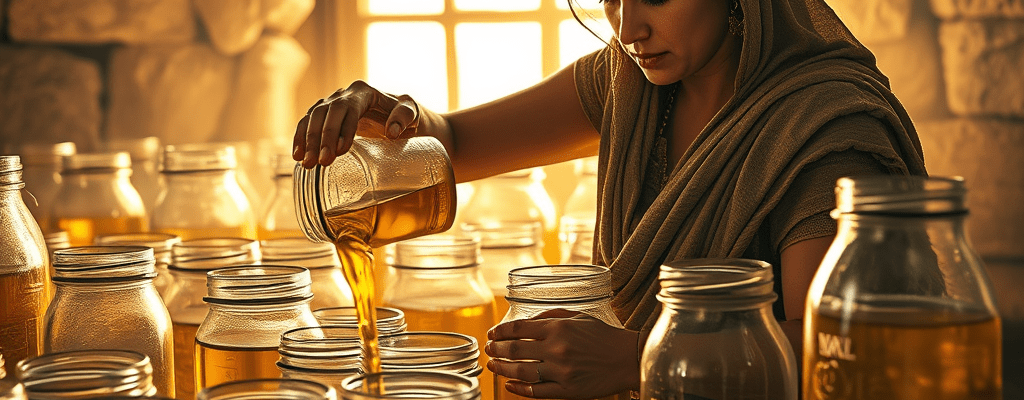
2 Kings 4:1–7 A man from the group of prophets had a wife. This man died, and his wife cried out to Elisha, “My husband was like a servant to you. Now he is dead! You know he honored the Lord. But he owed money to a man. Now that man is coming to take my two boys and make them his slaves!” 2 Elisha answered, “How can I help you? Tell me, what do you have in your house?” The woman said, “I don’t have anything in the house except a jar of olive oil.” 3 Then Elisha said, “Go and borrow bowls from all your neighbors. They must be empty. Borrow plenty of bowls. 4 Then go to your house and close the doors. Only you and your sons will be in the house. Then pour the oil into all the bowls. Fill them, and put them in a separate place.” 5 So the woman left Elisha, went into her house, and shut the door. Only she and her sons were in the house. Her sons brought the bowls to her and she poured oil. 6 She filled many bowls. Finally, she said to her son, “Bring me another bowl.” But all the bowls were full. One of the sons said to her, “There aren’t any more bowls.” Then the oil in the jar was finished! 7 When she told the man of God what had happened, Elisha said to her, “Go, sell the oil and pay your debt. You and your sons can live on the money that is left.”
Joh.2:6-10 There were six large stone waterpots there that were used by the Jews in their washing ceremonies. Each one held about 20 or 30 gallons. 7 Jesus said to the servants, “Fill the waterpots with water.” So they filled them to the top. 8 Then he said to them, “Now dip out some water and take it to the man in charge of the feast.” So they did what he said. 9 Then the man in charge tasted it, but the water had become wine. He did not know where the wine had come from, but the servants who brought the water knew. He called the bridegroom 10 and said to him, “People always serve the best wine first. Later, when the guests are drunk, they serve the cheaper wine. But you have saved the best wine until now.”
God is a God of abundance, not scarcity. He is Jehovah Jireh—the God who provides (Genesis 22:14). But while God’s supply is infinite, our ability to receive is not. This limitation often stems from our own perceptions, past experiences, and the doubts we harbor. It’s essential to recognize that, although we may feel unworthy or undeserving of His provisions, God’s grace extends far beyond our human understanding. Furthermore, as we open our hearts and minds to His abundant blessings, we create space for miracles to manifest in our lives. The journey of faith invites us to trust in His unending generosity, fostering a deeper connection with the divine source of all that we need.
In 2 Kings 4:1–7, Elisha tells a desperate widow to gather as many empty jars as she can, assuring her that God would miraculously fill them with oil to provide for her needs. The oil flowed without stopping until every jar she had collected was full—then, and only then, did the oil cease. This story beautifully illustrates that the blessings we receive are often limited not by God’s power, but by the size of our preparation and faith. If she had gathered more jars, she would have received more oil; if fewer, then less. In the same way, God’s provision in our lives often matches the faith, expectancy, and room we make for Him. Our “containers”—our hearts, faith, vision, and obedience—determine how much of His abundant supply we are able to receive.
“God’s blessings are not determined by His willingness to give, but by our readiness to receive.”
In John 2:6–10, Jesus’ first miracle at the wedding in Cana reveals a profound principle: the measure of blessing we receive often corresponds to the size of our preparation and faith. The six large stone waterpots, each capable of holding 20 to 30 gallons, symbolize the vessels we present before God. When the servants obeyed and filled the pots to the brim, Jesus transformed the ordinary water into extraordinary wine—abundant and of the highest quality. Likewise, when we come before God with hearts wide open, with great expectation and readiness, He fills us according to the “capacity” we offer Him. Had they only partially filled the pots, the miracle would have been smaller; but because they prepared fully, the blessing overflowed. In our lives, the extent of God’s outpouring often matches the size of our faith, surrender, and preparation, reminding us to always present a large, expectant vessel before Him.
1. We Are Loved and Blessed — If You Prepare the Container, God Will Fill It
Text:
2 Kings 4:3 — “Then Elisha said, ‘Go and borrow vessels from all your neighbors—empty vessels; do not gather just a few.'”
Theological Insight:
In the story of the widow and Elisha, the miracle of provision depended not only on God’s power, but also on the widow’s obedience to prepare containers. Elisha instructed her to gather empty vessels—and the flow of oil only continued as long as there were vessels to fill.
The principle is timeless: God’s blessings are abundant, but the extent to which we receive them is determined by the space we make ready. Empty, prepared containers represent our readiness—our faith, humility, and hunger for God’s provision.
If we bring no containers, or only a few, we limit the outpouring. But if we prepare plenty, trusting and expecting, God’s supply will not run out until we reach the limit of our preparation.
“God’s supply is limitless; our capacity is limited by our preparation and expectation.” — Charles Spurgeon
God delights to fill what we prepare. Our job is to present vessels—lives open, ready, and expectant.
Applications:
1. Believe You Are Already Loved and Invited to Receive
The widow wasn’t told to deserve oil; she was simply told to prepare for it. Likewise, we don’t work to earn God’s favor—we prepare because He has already invited us into His provision.
2. Prepare Specific Containers God Can Fill:
Many wait for God’s blessing, but few prepare the container to receive it. @budihidajat88
- Faith — Faith opens the door for God’s supernatural provision. Prepare your heart daily with trust and expectancy.
➔ Hebrews 11:6 — “Without faith it is impossible to please God…”“Faith sees the invisible, believes the unbelievable, and receives the impossible.” — Corrie ten Boom - Character — Blessings require strong vessels to sustain them. Prepare by cultivating integrity, humility, and perseverance.
➔ Proverbs 4:23 — “Above all else, guard your heart, for everything you do flows from it.”“Talent can take you where character cannot sustain you.” — Christine Caine - Knowledge and Wisdom — Grow in your understanding of God’s Word, life skills, and wisdom to handle greater responsibilities.
➔ Proverbs 4:7 — “Wisdom is supreme—so get wisdom. And whatever else you get, get understanding.”“An investment in knowledge pays the best interest.” — Benjamin Franklin (often quoted by Christian educators) - Positive Attitude — Hopeful, grateful hearts prepare the atmosphere for God’s blessing to flow freely.
➔ Philippians 4:8 — “Whatever is true, whatever is noble… think about such things.”“The pessimist sees difficulty in every opportunity. The optimist sees opportunity in every difficulty.” — Winston Churchill - Humility — Humility keeps the container open and usable for God. It acknowledges our dependence on Him and makes room for His grace to abound.
➔ James 4:6 — “God opposes the proud but shows favor to the humble.”“Humility is not thinking less of yourself; it is thinking of yourself less.” — C.S. Lewis
Miracles unfold when God’s blessing meets our faithful preparation. @budihidajat88
3. Remove What Hinders the Flow
God instructed the widow to gather empty vessels. We must remove pride, bitterness, unbelief, and distractions—so that our hearts are truly empty and ready for God to fill.
➔ Hebrews 12:1 — “Let us throw off everything that hinders and the sin that so easily entangles.”
“Before God can fill us, we must first be emptied of ourselves.” — A.W. Tozer
God’s supply is endless, but His outpouring is limited only by the size, readiness, and emptiness of the containers we prepare for Him.
2. Growth Mindset — God Will Fill What You Prepare
Text:
John 2:6–7 — “Now there were six stone water jars there for the Jewish rites of purification, each holding twenty or thirty gallons. Jesus said to the servants, ‘Fill the jars with water.’ And they filled them up to the brim.”
Theological Insight:
At the wedding in Cana, the servants were commanded to fill six large waterpots completely—to the brim—before the miracle took place. Their preparation determined the amount of blessing that could be released. Had they filled the jars halfway, they would have limited the wine Jesus provided.
This principle illustrates the importance of having a growth mindset in the kingdom of God. Growth mindset means believing that, by God’s grace, your life, faith, and impact can continually expand. It means preparing your life fully, even when you do not immediately see the results, because you trust that God will fill what you faithfully offer.
God’s blessings are not random; they flow into prepared, expectant, and expanding containers. Growth doesn’t happen passively—it is fueled by faith, effort, and the belief that God is committed to enlarging what we commit to Him.
“God will meet you where you are, but He will not leave you where you are.” — Max Lucado
Container Illustration:
Fixed mindsets are like capped containers—sealed off, rigid, and resistant. No matter how much God desires to pour into them, they cannot expand to receive His fullness. A person with a fixed mindset clings to old limitations, past failures, or rigid self-definitions, unconsciously placing a lid on what God can do through them.
Fixed mindsets are like capped containers—no matter how much God pours, they can’t expand.
In contrast, a growth mindset removes the lid. It is like presenting God with an ever-expanding vessel: willing to be stretched, reshaped, and filled anew. This mindset, rooted in humility, accepts correction, embraces challenges, learns from trials, and eagerly welcomes change, believing that God’s work is not finished yet (Philippians 1:6). Every act of surrender, every choice to trust and obey, enlarges the “container” of our lives, allowing God to pour in more wisdom, character, fruitfulness, and joy.
When we prepare large containers—hearts open to growth, minds ready for renewal, spirits hungry for transformation—we position ourselves to experience greater measures of God’s blessing and purpose. The oil flows where there is room. The wine fills where there are vessels. The transformation happens where there is a willing heart. Therefore, nurture a growth mindset: expect that God can and will grow you far beyond what you are today, as you cooperate with His Spirit.
Applications:
1. Keep Expanding Your Capacity
Growth doesn’t stop at salvation—it continues as we intentionally enlarge our hearts, minds, and faith. Just like the servants filled the waterpots to the brim, we are called to keep expanding the space in our lives for God’s work.
Expand your capacity by stretching your faith through prayer, learning new skills, deepening biblical knowledge, and stepping out in obedience even when it’s uncomfortable.
When you expect more from God and yourself, you prepare yourself for greater responsibility and greater blessing.
➔ Isaiah 54:2 — “Enlarge the place of your tent, stretch your tent curtains wide, do not hold back; lengthen your cords, strengthen your stakes.”
“Don’t limit your challenges—challenge your limits.” — Jerry Dunn
2. Welcome Correction and Stretching
A growth mindset embraces correction, feedback, and refinement. Growth often comes through discomfort: stretching past pride, letting go of old thinking, and embracing the hard lessons God sends through mentors, Scripture, and life experiences.
Without correction, we remain stuck in immaturity. Welcoming correction transforms our character and enlarges our spiritual container to carry more of God’s blessing.
➔ Proverbs 12:1 — “Whoever loves discipline loves knowledge, but whoever hates correction is stupid.”
➔ Hebrews 12:11 — “No discipline seems pleasant at the time, but painful. Later on, however, it produces a harvest of righteousness and peace for those who have been trained by it.”
“God loves you just as you are, but He refuses to leave you that way. He wants you to be just like Jesus.” — Max Lucado
3. Invest in Habits That Shape Your Mindset
Growth is not automatic—it is cultivated by daily habits that align your mind with God’s truth.
Feed your heart and mind with Scripture, prayer, godly conversations, and learning. Protect your thoughts from negativity, comparison, and passivity.
Forming daily habits of renewal shapes a container that is flexible, strong, and ready to receive more of God’s blessing.
➔ Romans 12:2 — “Do not conform to the pattern of this world, but be transformed by the renewing of your mind…”
➔ Philippians 4:8 — “Whatever is true, whatever is noble, whatever is right, whatever is pure… think about such things.”
“Sow a thought, reap an action; sow an action, reap a habit; sow a habit, reap a character; sow a character, reap a destiny.” — Stephen Covey
Your growth is not limited by God’s willingness—it’s limited by your willingness to expand, stretch, and renew your mind through faithful preparation.
3. Surround Yourself with Wise Counsel
Text:
2 Kings 4:1–2 — “A man from the group of prophets had a wife. This man died, and his wife cried out to Elisha, ‘My husband was like a servant to you. Now he is dead! You know he honored the Lord. But he owed money to a man. Now that man is coming to take my two boys and make them his slaves!’ Elisha answered, ‘How can I help you? Tell me, what do you have in your house?’ The woman said, ‘I don’t have anything in the house except a jar of olive oil.'”
Theological Insight:
When the widow faced a crisis that threatened her sons’ future, she turned to Elisha—a man filled with God’s wisdom—for counsel. Elisha did not solve her problem by giving her money; he gave her instruction on how to prepare for God’s provision. His wisdom helped her recognize that even her small jar of oil, when offered in faith and obedience, could become the seed for a miracle.
This shows the vital role wise counsel plays in helping us prepare our containers for God’s blessings. Wise counselors help us see possibilities when we only see problems. They guide us to take faithful, practical steps that expand our capacity for God’s provision.
Without Elisha’s counsel, the widow might have lost hope, missed the miracle, and seen her sons enslaved. Wise counsel often unlocks the strategies and faith needed to prepare for the blessings God wants to pour into our lives.
“Sometimes God’s greatest gifts come not through immediate answers, but through wise instructions.” — Charles Stanley
Proverbs 15:22 “Without counsel plans fail, but with many advisers they succeed.”
Proverbs 15:22 highlights that wise counsel is not just helpful—it is essential for success and growth. In the context of preparing our “containers” for God’s blessings, surrounding ourselves with wise counselors enlarges our understanding, sharpens our discernment, and strengthens our readiness to steward more. God often chooses to grow and guide us through the voices of trusted mentors, spiritual leaders, and wise friends. By listening to their counsel, we expand the capacity of our minds and hearts to receive more of God’s wisdom and direction. Growth rarely happens in isolation; it flourishes in community with the wise. Just as the widow in 2 Kings 4 experienced provision through Elisha’s guidance, so too we position ourselves for greater blessings when we humbly receive counsel from those rooted in godly wisdom. Wise counsel enlarges the “container” of our lives, preparing us for the abundance God wants to pour in.
“It takes humility to seek counsel; it takes wisdom to recognize it.” – Rick Warren
Elisha served as a prophetic voice to the widow. Without him, she may have lost her sons. Sometimes, God’s direction doesn’t come through a dream or angel—but through a friend, pastor, or mentor.
Application:
1. Pursue Counsel That Challenges and Stretches You
Don’t settle for advice that simply affirms what you already believe. Seek out mentors, pastors, and godly friends who will lovingly challenge your thinking, correct your blind spots, and call you higher. Their wisdom will stretch the limits of your current “container,” helping you grow into someone who can receive and steward greater blessings from God.
➔ Proverbs 27:6 — “Wounds from a friend can be trusted, but an enemy multiplies kisses.”
➔ Proverbs 13:20 — “Walk with the wise and become wise, for a companion of fools suffers harm.”
“The wise are those who welcome correction more than confirmation.” — Tim Keller
2. Filter Counsel Through God’s Word and Prayer
Not every piece of advice is godly counsel. Test what you hear against Scripture and bring it before God in prayer. Wise counsel should align with biblical truth and cultivate spiritual maturity, not just personal comfort. As you learn to discern good counsel, your heart and mind expand in wisdom, making you more capable of walking in the fullness of God’s plans.
➔ 1 Thessalonians 5:21 — “But test them all; hold on to what is good.”
➔ Psalm 119:105 — “Your word is a lamp for my feet, a light on my path.”
“When advice contradicts God’s Word, it’s not wisdom—it’s deception.” — A.W. Tozer
3. Stay Connected to a Community of Growth
Isolate yourself, and your container shrinks. Stay planted in a healthy church community, small groups, or leadership circles where wise voices consistently speak into your life. Community keeps you sharp, accountable, and growing. Regular exposure to godly counsel and shared wisdom enlarges your faith, your vision, and your capacity to carry greater blessings.
➔ Hebrews 10:24–25 — “And let us consider how we may spur one another on toward love and good deeds, not giving up meeting together… but encouraging one another.”
➔ Ecclesiastes 4:9–10 — “Two are better than one, because they have a good return for their labor: If either of them falls down, one can help the other up.”
“You cannot grow spiritually if you remain isolated relationally.” — Rick Warren
The size of your future blessing often depends on the wisdom you are willing to receive today. Surround yourself with wise counsel, and you will not only grow your container—you will prepare your life to overflow with the abundance God desires to pour into you.
4. Know What God Has Already Invested in You — Value and Develop Your Seed
Text:
John 6:9 — “Here is a boy with five small barley loaves and two small fish, but how far will they go among so many?”
Theological Insight:
In the miracle of feeding the 5,000, Jesus didn’t create bread and fish out of nothing—He used what was already available, no matter how small it seemed. The boy’s offering of five loaves and two fish became the seed for a miracle of multiplication. Likewise, God has already placed gifts, talents, ideas, resources, and spiritual seeds inside each of us. These “small beginnings” may look insignificant, but when we offer them fully to God and nurture them with faith, they become the foundation of extraordinary blessing.
The miracle didn’t depend on the size of the initial resource—it depended on the willingness to offer it, and the readiness to put it in Jesus’ hands. God multiplies what we prepare and surrender. But if we refuse to recognize or offer what we have, the container remains small, and we limit what God can pour into our lives.
“God does not need much to do great things. He only needs all you have.” — Vance Havner
Applications:
1. Small Is Big — Offer Whatever You Have
Don’t underestimate the value of what’s already in your hands. Five loaves and two fish fed thousands because they were given to Jesus. Your skills, your ideas, your opportunities—no matter how small—are seeds of future miracles. Faithfulness in small things expands your container for greater blessings.
“God always begins with what He has already placed in your hands—and what seems small becomes big when He is in it.” @budihidajat88
2. Slow Is Fast — Growth and Multiplication Are Often Gradual
The boy’s offering became a miracle instantly in Jesus’ hands, but in our lives, God’s multiplication usually comes through steady, faithful stewardship. As you consistently sow, nurture, and trust God with what you have, growth compounds over time. Quick shortcuts may promise speed but often lead to shallow outcomes. True capacity-building is slow, but it is sure and lasting.
“When a seed grows its roots, the growth seems slow—but it’s laying the foundation for rapid growth when the time is right.” @budihidajat88
3. Practical Steps to Grow What God Has Invested in You:
- Identify what you already have — List your God-given skills, passions, and resources. Nothing is too small when placed in God’s hands.
- Surrender it completely to Jesus — Pray over your gifts daily, asking God to bless, use, and multiply them for His glory.
- Invest and cultivate your gifts — Develop your skills, nurture your character, and step out to serve, even in small ways.
- Stay patient and expectant — Growth happens both above and below the surface. Trust God to multiply your “loaves and fish” in His perfect timing.
“The season of hidden growth is not wasted—it’s building strength for a future you cannot yet see.” @budihidajat88
The miracle is not in how much you start with—it’s in what you are willing to offer and prepare. When you place your small “container” into Jesus’ hands, He multiplies it beyond what you could ever imagine.
5. Grit — Persevere in Preparing a Bigger Container
Text:
- 2 Kings 4:3 — “Then Elisha said, ‘Go and borrow bowls from all your neighbors. They must be empty. Borrow plenty of bowls.'”
- 2 Kings 4:6 — “When all the bowls were full, she said to her son, ‘Bring me another one.’ But he replied, ‘There is not a bowl left.’ Then the oil stopped flowing.”
Theological Insight:
The widow’s miracle wasn’t automatic—it required action, endurance, and effort.
Elisha didn’t tell her how many bowls to borrow; he simply told her to gather many. She had to go house by house, neighbor by neighbor, asking, explaining, and collecting. That took grit—persistent faith in motion.
The oil only stopped flowing when she had no more bowls left to fill. If she had given up halfway—if she had settled for a few bowls—she would have limited the miracle.
Grit means staying faithful to the preparation even when it’s tedious, slow, or tiring. It means gathering “one more bowl” when you’re tempted to stop. God’s provision flows where perseverance has made room.
“Many people stop just one step away from their miracle.” @budihidajat88
Hebrews 10:36 — “You need to persevere so that when you have done the will of God, you will receive what he has promised.”
Hebrews 10:36 reminds us that perseverance is not optional if we want to receive the fullness of God’s promises. Blessing follows obedience, but obedience must often be sustained over time, through difficulty, fatigue, and even seasons of silence. Building a larger container—expanding our character, faith, wisdom, and skills—requires long-term grit: the ability to stay faithful and committed even when results are slow or resistance is strong.
Without grit, the preparation stops midway. Without perseverance, the vessel remains too small to carry the weight of the blessing God has intended. Grit grows the container until it is strong enough, big enough, and deep enough to handle God’s outpouring without breaking.
As Eugene Peterson describes the Christian life, it is “a long obedience in the same direction.”
True spiritual grit—empowered by grace—is what turns small beginnings into great outcomes.
“Let us not become weary in doing good, for at the proper time we will reap a harvest if we do not give up.” (Galatians 6:9, NIV)
Grit is the spiritual muscle that keeps you moving forward when everything inside you says to quit. In Galatians 6:9, Paul reminds believers that the harvest is certain, but the timing is not immediate. There is often a long season between the sowing of faithfulness and the reaping of reward. Weariness tempts us to stop gathering bowls, to stop pouring oil, to stop believing that preparation matters. But grit—the steadfast determination to keep doing good without visible results—is what positions us to receive the full blessing at the appointed time.
Keep Preparing Even When You Don’t See Immediate Results.
The widow kept gathering bowls even before the oil started flowing. Likewise, grit means continuing to prepare, work, and obey even when you don’t yet see the blessing.
“Grit is living life like it’s a marathon, not a sprint.” — Angela Duckworth
(*From her book Grit: The Power of Passion and Perseverance)
The promise of a harvest is conditional: it comes to those who do not give up. Giving up too soon is like abandoning a field just before the crops break through the ground. Many people forfeit their miracle not because God wasn’t faithful, but because they surrendered too early.
Grit ties preparation and promise together. It fuels the daily, unseen obedience that God uses to bring about visible breakthrough.
“The future belongs to the disciplined, not the merely passionate.” — John Maxwell
Applications:
1. Why Grit Plays an Important Part in Building a Bigger Container:
- Grit sustains the building process when feelings fade.
Blessing demands preparation, and preparation demands perseverance. Without grit, we abandon the process too soon, leaving our container half-formed and unready.
➔ Hebrews 6:12 — “We do not want you to become lazy, but to imitate those who through faith and patience inherit what has been promised.” - Grit enlarges our spiritual and emotional capacity.
Trials stretch and strengthen us, forging deeper character and greater resilience—building a container capable of sustaining greater blessing.
➔ James 1:4 — “Let perseverance finish its work so that you may be mature and complete, not lacking anything.”
“Success is not final, failure is not fatal: it is the courage to continue that counts.” — Winston Churchill
2. How to Build Grit to Prepare a Bigger Container:
- Focus on Faithfulness, Not Feelings.
Decide each day to trust and obey God, regardless of how you feel. Build grit by anchoring your choices in conviction, not emotion.
➔ 2 Corinthians 5:7 — “For we walk by faith, not by sight.” - Expect Trials as Tools, Not Obstacles.
See resistance not as failure, but as God’s instrument for growth. Challenges are opportunities to stretch your container wider.
➔ Romans 5:3–4 — “We also glory in our sufferings, because we know that suffering produces perseverance; perseverance, character; and character, hope.” - Rely on God’s Strength, Not Your Own.
True grit is not just human stubbornness—it is spiritual perseverance empowered by grace. Pray daily for renewed strength.
➔ Philippians 4:13 — “I can do all this through him who gives me strength.”
“It is not talent or opportunity that makes the difference; it is perseverance.” — Charles Spurgeon
3. Practical Habits to Build and Maintain Grit:
- Establish Daily Spiritual Disciplines — Small daily habits (prayer, Scripture, gratitude) reinforce your endurance muscle.
➔ Luke 16:10 — “Whoever is faithful in very little is also faithful in much…” - Measure Progress by Faithfulness, Not Immediate Results — Stay committed to the process even if fruit is not yet visible.
➔ Galatians 6:9 — “Let us not become weary in doing good, for at the proper time we will reap a harvest if we do not give up.” - Stay Connected to Encouraging Community — Perseverance grows stronger when you walk with others who will lift you up.
➔ Hebrews 10:24–25 — “And let us consider how we may spur one another on toward love and good deeds, not giving up meeting together… but encouraging one another.” - Speak God’s Promises Over Your Journey — Declare God’s truth over your efforts to reinforce hope and resilience.
➔ 2 Corinthians 4:16 — “Therefore we do not lose heart. Though outwardly we are wasting away, yet inwardly we are being renewed day by day.”
“Perseverance is falling 19 times and succeeding the 20th.” — Julie Andrews
Grit is the unseen hand that keeps building when results are not yet visible. Perseverance enlarges the container of your life until it is strong enough, deep enough, and durable enough to carry the weight of the blessing God is preparing for you.
6. Faith — Trust God to Fill What You Prepare
Text: 2 Kings 4:4–5 — “Then go to your house and close the doors. Only you and your sons will be in the house. Then pour the oil into all the bowls. Fill them, and put them in a separate place. So the woman left Elisha, went into her house, and shut the door. Only she and her sons were in the house. Her sons brought the bowls to her and she poured oil.”
Theological Insight:
The widow’s faith was demonstrated not just by asking for help, but by acting on Elisha’s instruction—before she saw any miracle. She shut the door, gathered the bowls, and started pouring, even though she only had a small jar of oil. In the natural, it didn’t make sense to pour out so little into so many empty containers, but her actions revealed her faith:
She prepared space and trusted God to fill it.
Faith always involves action based on trust in God’s word, not sight or feelings. If she had waited to see full jars first, there would have been no miracle.
The oil flowed only after she prepared the containers and acted in faith.
Similarly, in our lives, God’s blessings often flow only after we step forward in obedience, preparing and believing that He will fill what we offer to Him.
“Faith is acting like God is telling the truth.” — Tony Evans
Hebrews 11:6 — “And without faith it is impossible to please God, because anyone who comes to him must believe that he exists and that he rewards those who earnestly seek him.”
After all the preparation—gathering jars, enlarging our hearts, nurturing our gifts, persevering in growth, exercising discernment—faith is essential ingredient. Preparing the container is our responsibility; filling it is God’s. We must trust that when we prepare in obedience, even if we cannot yet see the blessing, God is faithful to fill what we have surrendered.
Faith is the bridge between preparation and fulfillment. Without faith, we might stop preparing too soon or doubt whether God will honor our obedience. With faith, we keep building, stretching, and enlarging, confident that God rewards those who diligently seek and prepare according to His call.
“Faith is taking the first step even when you don’t see the whole staircase.” — Martin Luther King, Jr.
Applications:
1. Why Faith Is Crucial for Preparing Your Container:
- Faith keeps you preparing even when you don’t see immediate results.
➔ 2 Corinthians 5:7 — “For we live by faith, not by sight.” - Faith fuels hope and endurance when the process feels slow or hidden.
➔ Romans 8:25 — “But if we hope for what we do not yet have, we wait for it patiently.” - Faith honors God’s sovereignty, trusting His perfect timing and provision.
➔ Isaiah 55:8–9 — “For my thoughts are not your thoughts, neither are your ways my ways,” declares the LORD.
“God is never late and rarely early. He is always exactly right on time.” — Charles R. Swindoll
2. Prepare in Faith, Not Just by Sight
Faith enables us to keep preparing even when we cannot yet see results. If you only prepare when you see visible evidence, you limit your container. True faith prepares in advance, believing that God’s promise will come to pass.
➔ 2 Corinthians 5:7 — “For we live by faith, not by sight.”
3. How to Strengthen Your Faith While Preparing Your Container:
- Meditate daily on God’s promises.
Faith grows by hearing and absorbing the Word of God (Romans 10:17). - Pray bold, expectant prayers.
Keep asking, seeking, and knocking, believing God honors perseverance (Matthew 7:7–8). - Testify to small fulfillments.
Celebrate and remember how God has already been faithful—it builds expectation for greater things (Psalm 77:11–12). - Stay rooted in a community of faith.
Encouragement from other believers strengthens faith during seasons of waiting and preparing (Hebrews 10:24–25).
“When God sees you doing your part—developing what He has given you—then He will do His part and open doors no man can shut.” — Joel Osteen
Faith is the hand that holds the container steady until God’s blessings overflow into it. Prepare with all your heart—and trust with all your faith—that God will not waste your preparation.
7. Discernment — Knowing When to Say “Enough”
Text: 2Kings 4:6-7 She filled many bowls. Finally, she said to her son, “Bring me another bowl.” But all the bowls were full. One of the sons said to her, “There aren’t any more bowls.” Then the oil in the jar was finished! 7 When she told the man of God what had happened, Elisha said to her, “Go, sell the oil and pay your debt. You and your sons can live on the money that is left.”
Theological Insight:
In the miracle of the widow’s oil, the provision of God continued until the prepared containers were completely full. Once there were no more vessels, the oil stopped.
This moment teaches us that discernment is vital—not just to know when to gather and prepare—but also when to recognize completion, contentment, and stewardship.
Without discernment, we can either stop preparing too soon (limiting our blessing) or strive endlessly, trying to gather more without purpose.
Knowing when to say “enough” is about recognizing the season God has brought to fulfillment, giving thanks, and stewarding the blessing rather than chasing endlessly after “more.”
Sometimes faith prepares for more; other times wisdom says, “It is enough.” True discernment knows the difference.
“Contentment is not the fulfillment of what you want, but the realization of how much you already have.” — Warren Wiersbe
Proverbs 30:8–9 — “Give me neither poverty nor riches, but give me only my daily bread. Otherwise, I may have too much and disown you and say, ‘Who is the LORD?’ Or I may become poor and steal, and so dishonor the name of my God.”
Proverbs 30 offers a profound prayer of balance and discernment. It shows that blessing is not just about how much we receive—but about having the right heart to handle it. Sometimes, enlarging our container isn’t about constantly striving for more—it’s about wisely recognizing when enough has been reached, so that the blessing remains a blessing and does not become a burden.
Without discernment, even good things can overflow the boundaries of our character, leading to pride, self-reliance, or even destruction. Discernment protects the container we’ve carefully built; it ensures that the blessings God pours in do not end up harming us.
Saying “enough” at the right time is not about limiting God’s blessing—it’s about honoring His wisdom and keeping our heart anchored in dependence on Him.
“Abundance is not measured by how much you have, but by how wisely you manage what you have.” — John C. Maxwell
Applications:
1. Why It Is Important to Have Discernment to Say “Enough”:
- Protects the heart from pride and self-sufficiency.
➔ Deuteronomy 8:17–18 — “You may say to yourself, ‘My power and the strength of my hands have produced this wealth for me.’ But remember the LORD your God, for it is he who gives you the ability to produce wealth…” - Preserves the purpose of the blessing—to glorify God, not self.
➔ 1 Timothy 6:6 — “But godliness with contentment is great gain.” - Prevents the container from cracking under the weight of greed, anxiety, or misplaced priorities.
➔ Ecclesiastes 5:10 — “Whoever loves money never has enough; whoever loves wealth is never satisfied with their income.”
“More is not always better; sometimes more is heavier, messier, and deadlier.” — Craig Groeschel
2. How to Know When to Say “Enough”:
- When the blessing starts replacing the Blesser.
If your pursuit of more makes you distant from God, it’s time to pause and re-center your heart.
➔ Matthew 6:33 — “But seek first his kingdom and his righteousness, and all these things will be given to you as well.” - When it compromises your character, relationships, or peace.
Blessings should deepen your integrity and relationships, not erode them. If more is causing more compromise, it’s time to say “enough.”
➔ Proverbs 14:30 — “A heart at peace gives life to the body, but envy rots the bones.” - When your container is full for this season.
Sometimes God brings a season to pause, stabilize, and steward what He has given, rather than constantly expanding.
➔ Ecclesiastes 3:1 — “There is a time for everything, and a season for every activity under the heavens.”
“Knowing when to stop is as important as knowing when to start.” — Anonymous
3. Steward What God Has Already Given
After the oil filled all the jars, the widow didn’t panic or demand more jars—she shifted to stewarding the blessing God had poured out. True maturity is seen when we care for what God has given us rather than constantly chasing what we don’t yet have.
➔ Luke 16:10 — “Whoever can be trusted with very little can also be trusted with much…”
“Before God multiplies, He measures how we manage.” — Craig Groeschel
Discernment helps you recognize when your container is full for now—protecting the blessing, preserving your heart, and positioning you to honor God with what you have already received. A discerning heart knows when to act, when to wait, and when to walk away.
CONCLUSION: What Kind of Container Are You?
The widow did not determine how long the oil would flow—she only determined how many containers she would bring. The oil stopped only when the vessels ran out.
God’s supply is endless, but our capacity is not.
God desires to pour out His abundant blessings, but He fills only what we prepare. If we prepare small containers, we receive small measures; if we prepare enlarged hearts, stretched faith, and deepened character, He entrusts us with more than we can imagine.
We prepare by expanding our mindset, seeking wise counsel, strengthening our determination, valuing the seed already invested in us, persevering through grit, exercising discernment to know when enough is enough, and walking by faith that God will fill what we offer.
The miracle is not in the size of what you start with—it’s in your willingness to prepare, to grow, and to trust.
Build the biggest container your heart can hold—and watch God pour blessing, purpose, and fruitfulness into every part of your life, pressed down, shaken together, and running over.
 budi hidajat