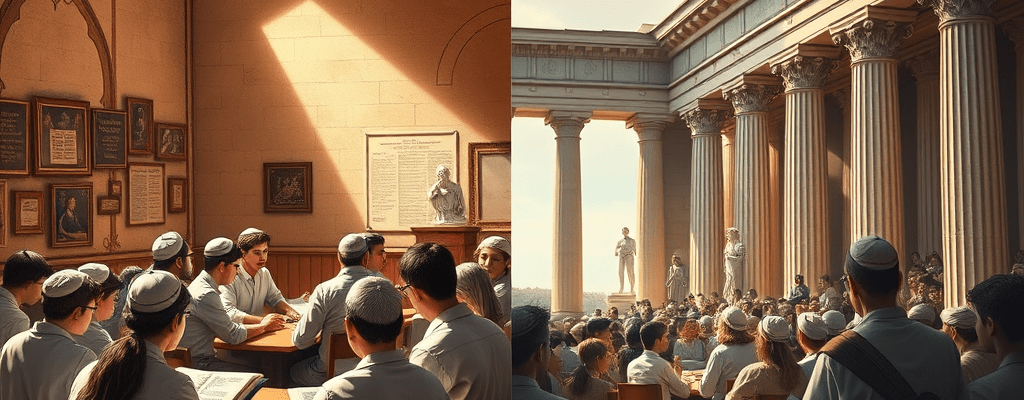
Christian education today is often influenced by Greek and Roman classical philosophy, while the Jewish system of education, which Jesus Himself was trained in, is often overlooked. A truly biblical Christian school should be rooted in Jewish educational principles and a biblical worldview, rather than the Greek-Roman model that has shaped much of Western education.
This comparison will highlight the differences between Jewish education (biblical approach) and Greek-Roman classical education (philosophical approach) and why Christian schools should prioritize the biblical-Jewish model.
1. Core Differences Between Jewish and Greek-Roman Education
| Feature | Jewish Education (Biblical Model) | Greek-Roman Education (Classical Model) |
|---|---|---|
| Worldview | God-centered (Theocentric) – Learning is a sacred duty to know God and obey His commands. | Man-centered (Humanistic) – Focuses on human reason, intellectual development, and philosophy. |
| Purpose of Education | Spiritual & Moral Development – To shape a person’s faith, character, and relationship with God (Deuteronomy 6:7). | Intellectual Excellence & Civic Leadership – To shape individuals into rational, persuasive leaders for society. |
| Teaching Method | Lifelong learning, mentorship, and community-based education (e.g., Havruta & Beit Midrash). | Socratic Method (debate and questioning), formal logic, and rhetoric training. |
| Authority of Knowledge | God’s Word (Torah & Scripture) is the ultimate source of truth. | Human Reason (Plato, Aristotle, Stoicism) and secular ethics shape knowledge. |
| Character Formation | Mussar (Ethical Growth) – Learning leads to personal holiness, humility, and service. | Virtue Ethics – Learning leads to civic virtue, persuasive rhetoric, and societal success. |
| Focus of Study | Torah, Prophets, Wisdom Literature, and God’s commands. | Classical Literature (Homer, Plato, Aristotle, Cicero, Augustine, etc.). |
| Community Role | Parents & Religious Community are responsible for education. | State, Philosophers, and Educators control the education system. |
2. Biblical-Jewish Education vs. Classical Greek-Roman Thinking
A. Purpose of Education: Knowing God vs. Intellectual Mastery
- Jewish Education: Deuteronomy 6:4-9 commands parents to teach their children to love God and follow His commandments. This biblical directive emphasizes the importance of instilling these principles from a young age, through both everyday life and dedicated study. Parents are encouraged to engage in meaningful discussions about faith, ensuring these values are woven into the fabric of daily routines, from morning until night.
- Greek Education: Plato’s Republic and Aristotle’s Nicomachean Ethics argue that education should create ideal citizens and philosophers for the state, emphasizing the importance of cultivating moral virtues, critical thinking skills, and civic responsibility to ensure a just and harmonious society in which individuals contribute positively to the common good.
Christian Schools Should…
- Prioritize spiritual formation and biblical character development over academic prestige, recognizing that true growth in faith and understanding often comes from deep personal reflection and engagement with scripture, rather than merely achieving accolades or titles in academic settings.
- Teach that wisdom comes from God, not just intellectual ability, emphasizing the importance of seeking divine guidance and understanding in all aspects of life, as illustrated in Proverbs 9:10, which reminds us that the fear of the Lord is the beginning of wisdom and that true insight can only be attained through a relationship with the Creator.
B. Teaching Method: Inquiry-Based Learning vs. Philosophical Debate
- Jewish Education (Havruta & Midrashic Study):
- Encourages questioning within a biblical framework, always seeking God’s wisdom in all aspects of life and bringing in scripture for deeper understanding and clarity.
- The Talmudic method focuses on deep study of God’s laws with practical application, encouraging detailed analysis, discussion, and debate to better understand the nuances and complexities of these sacred texts, ultimately guiding adherents in their daily lives and ethical decisions.
- Greek-Roman Education (Socratic Method & Classical Debate):
- Encourages questioning for intellectual superiority rather than for spiritual growth.
- Classical education trains students in persuasion (rhetoric) rather than obedience to God.
Christian Schools Should…
- Use Havruta (paired study) and Midrash-style learning, where students analyze and apply God’s Word rather than just argue for argument’s sake, fostering deeper understanding and meaningful engagement with the text that encourages personal interpretation and communal discussion.
- Move away from pagan philosophy-based debate models that prioritize intellectual ego over biblical humility, recognizing that these approaches often lead to divisiveness and an emphasis on winning arguments rather than fostering understanding and compassion in discussions.
C. Character Formation: Holiness vs. Human Virtue
- Jewish Education: Mussar (Ethical Growth) emphasizes humility, honesty, and faithfulness to God, guiding individuals in their spiritual journey and encouraging them to cultivate a deeper understanding of their moral responsibilities towards themselves and others while fostering meaningful connections within their community.
- Greek-Roman Education: Virtue Ethics (Aristotle, Stoicism, Roman civic duty) focuses on developing skills for success and leadership, fostering critical thinking and moral character, while also emphasizing the importance of community involvement and personal responsibility in creating a well-rounded individual.
Christian Schools Should…
- Teach character development based on biblical virtues (love, faith, humility, patience) rather than Greco-Roman ideals (stoicism, self-sufficiency, honor-seeking), emphasizing the importance of internal growth and moral integrity, which fosters a deeper connection with oneself and others in the community, ultimately leading to a more compassionate and understanding society.
- Train students for faithful Christian living, not just leadership and eloquence, emphasizing the importance of integrity, compassion, and humility in their daily interactions and decision-making processes.
3. Curriculum Priorities: Biblical-Jewish vs. Classical Approach
| Jewish Biblical Education | Classical Greek-Roman Education |
|---|---|
| Torah, Psalms, Proverbs, Prophets | Homer, Plato, Aristotle, Cicero |
| Hebrew (Biblical Language Focus) | Latin & Greek (Western Philosophy Focus) |
| Talmudic Reasoning (Biblical Law & Ethics) | Logic & Rhetoric (Debate & Persuasion) |
| Focus on God’s Covenant & Commands | Focus on Human Thought & Political Theory |
Christian Schools Should…
- Replace pagan Greek philosophers with a biblical curriculum focused on the Torah, Proverbs, the teachings of Jesus, and the epistles of Paul, thereby ensuring a deeper understanding of foundational spiritual texts and their application in everyday life.
4. Community and Responsibility: Biblical Model vs. State-Controlled Education
- Jewish Education: Parents are the primary teachers (Deuteronomy 6:7), and the community supports learning through various resources, programs, and activities that enrich the educational experience, ensuring that both children and adults can engage in lifelong learning and deepen their understanding of Jewish traditions and values.
- Greek-Roman Model: The state or academy controls education, and students are trained for political roles.
Christian Schools Should…
- Encourage parent-led discipleship rather than relying solely on professional educators, emphasizing the importance of parents playing an active role in their children’s spiritual development and education within the community, thereby fostering deeper connections and understanding of faith at home.
- Build a community-based school model, where church, family, and school work together in discipleship to create an inclusive and supportive environment, fostering meaningful relationships and shared responsibilities for nurturing the next generation’s spiritual and academic growth.
5. Why Christian Schools Should Move Away from Greek-Roman Models
| Biblical-Jewish Model | Greek-Roman Model (Classical Education) |
|---|---|
| Education is for knowing and obeying God. | Education is for worldly wisdom and leadership. |
| Parents and community are responsible for raising godly children. | The state and philosophers shape children for civic roles. |
| Learning is lifelong and based on God’s Word. | Learning is for social status and personal excellence. |
| Character is built through faith and obedience. | Character is built through rhetoric, philosophy, and debate. |
Conclusion: Christian Schools Must Return to Biblical Roots
- Replace classical (Greek-Roman) education models with Jewish biblical education methods.
- Prioritize biblical character-building over debate, persuasion, and leadership skills.
- Focus on Torah, biblical wisdom, and spiritual formation rather than Western philosophy.
- Build a faith-based education system where parents, church, and community are actively involved.
- Teach students to seek wisdom from God, not just intellectual mastery.
Comparison of the Biblical Worldview and the Greek-Roman (Classical) Worldview
The Biblical worldview is God-centered (theocentric), relational, and rooted in divine revelation, whereas the Greek-Roman worldview is man-centered (humanistic), rationalistic, and based on human reasoning. These two worldviews shape education, ethics, leadership, and the understanding of truth in profoundly different ways.
1. Core Differences Between the Biblical & Greek-Roman Worldviews
| Category | Biblical Worldview (Hebraic) | Greek-Roman Worldview (Classical) |
|---|---|---|
| Source of Truth | God’s Word (Divine Revelation) – Truth comes from Yahweh’s revelation through Scripture (Psalm 119:160). | Human Reason & Philosophy – Truth is discovered through logic, debate, and philosophy (Plato, Aristotle, Stoicism). |
| Authority | God is the absolute authority; His laws define morality and governance (Isaiah 33:22). | Man is the measure of all things (Protagoras); human wisdom and government define ethics and law. |
| Purpose of Life | To glorify God, obey His commandments, and build His Kingdom (Ecclesiastes 12:13, Matthew 6:33). | To seek knowledge, personal fulfillment, and political influence (Greek Arete – personal excellence). |
| Human Nature | Created in God’s Image but fallen – Humanity’s purpose is to worship and serve God (Genesis 1:26-28, Romans 3:23). | Man as autonomous & rational – Humanity’s goal is self-improvement, logic, and civic duty. |
| Ethics & Morality | Objective morality – Right and wrong are defined by God’s law (Exodus 20, Leviticus 19:2). | Relative morality – Ethics are based on reason, virtue ethics, and societal norms (Aristotle’s Nicomachean Ethics). |
| Education & Knowledge | Wisdom begins with fearing the Lord (Proverbs 1:7); knowledge serves God’s will and Kingdom. | Knowledge is power – Learning aims to master logic, rhetoric, and philosophy to influence society. |
| Government & Leadership | Theocratic Leadership – Leaders are accountable to God’s laws (Exodus 18:21). | Democratic & Aristocratic Rule – Power is held by philosopher-kings (Plato) or an elite ruling class (Roman Senate). |
| Family & Society | Patriarchal, Covenant-Based Family – Families exist to train children in God’s ways (Deuteronomy 6:7, Ephesians 6:4). | Civic-Oriented Family – Families exist to produce citizens who serve the state. |
| View of Time & History | Linear View – History is God’s progressive unfolding of redemption (Genesis to Revelation). | Cyclical View – History repeats itself (rise and fall of civilizations, Greek eternal recurrence). |
2. Biblical vs. Greek-Roman Thought on Education
| Education Model | Biblical Worldview (Jewish Model) | Greek-Roman Worldview (Classical Model) |
|---|---|---|
| Purpose | To know and obey God (Deuteronomy 6:5-9). | To cultivate logic, rhetoric, and persuasion (Plato & Aristotle). |
| Methodology | Torah-based, relational, discipleship-centered. | Philosophy-based, intellectual, debate-driven. |
| Moral Education | Ethics derived from Scripture & divine revelation. | Virtue ethics from human wisdom (Aristotle, Stoicism). |
| Key Figures | Moses, Prophets, Jesus, Apostles (divine inspiration). | Socrates, Plato, Aristotle, Cicero (rational inquiry). |
Key Issues:
- The Biblical worldview sees education as a way to know God, emphasizing that learning is not merely an academic exercise but a spiritual journey aimed at understanding divine truths and deepening one’s faith. In contrast, the Greek worldview sees education as a way to develop human potential and gain power, focusing on the cultivation of intellect and rhetoric as tools for personal advancement and societal influence, where knowledge serves to empower individuals in a competitive landscape.
- Greek education promotes debate, rhetoric, and persuasion, encouraging students to engage in critical thinking and articulate their ideas effectively; Biblical education focuses on obedience to God and applying wisdom in real life, emphasizing the importance of moral integrity and the practical application of spiritual teachings.
3. Leadership & Governance: Biblical vs. Classical
| Leadership Model | Biblical Worldview (God’s Kingdom) | Greek-Roman Worldview (Human Government) |
|---|---|---|
| Authority | God rules through His Word (Psalm 2:10-12). | Rulers govern based on wisdom, democracy, or military strength. |
| Leadership Style | Servant Leadership (Jesus, Moses, David) – Leaders serve God and the people (Mark 10:45). | Philosopher-Kings (Plato), Strong Emperors (Caesar) – Leaders rule through intellect, strength, or conquest. |
| Role of the Law | God’s Law is supreme and unchanging (Psalm 19:7-11). | Laws evolve based on political needs and philosophy (Roman legal system). |
Key Issues:
- Biblical leadership requires submission to God’s will, prioritizing spiritual guidance and divine principles, while Greek-Roman leadership is based on intelligence, persuasion, and human reasoning, emphasizing strategic thinking and rhetoric in decision-making processes.
- The Roman model of government prioritizes empire expansion, conquest, and military power, emphasizing the importance of territorial dominance and strategic warfare, whereas the Biblical model prioritizes justice, righteousness, and serving God, focusing on moral integrity and the well-being of individuals in accordance with divine principles.
4. Comparison of Ethics & Morality
| Ethics | Biblical View | Greek-Roman View |
|---|---|---|
| Basis | God’s law (absolute morality). | Man’s reasoning (relative morality). |
| Virtues | Faith, humility, love, obedience (Galatians 5:22-23). | Honor, courage, excellence, glory (Greek Arete). |
| Role of Suffering | God refines His people through trials (James 1:2-4). | Stoicism: Accept suffering as fate, control emotions. |
Key Issues:
- Greek virtue ethics focus on man’s ability to develop moral excellence (Arete), emphasizing the importance of cultivating personal virtues through practice and experience in life. In contrast, biblical morality is based on humility, repentance, and obedience to God, stressing the necessity of aligning one’s actions with divine commandments and the moral teachings found in sacred texts.
- Biblical suffering leads to growth in faith; Greek suffering is a sign of fate or personal weakness, often perceived as a challenge to overcome, reflecting a deeper philosophical exploration of one’s purpose in life and the resilience of the human spirit.
5. View of Salvation & Eternal Life
| View of Salvation | Biblical Worldview (Jewish-Christian) | Greek-Roman Worldview (Pagan-Philosophical) |
|---|---|---|
| Salvation | By faith in God & obedience to His covenant (Ephesians 2:8-9). | Through virtue, philosophy, or heroic deeds. |
| Eternal Life | Resurrection & eternity with God (John 3:16). | Greek Elysium (a paradise for the virtuous), Stoic detachment, reincarnation. |
| Messiah | Jesus Christ – the fulfillment of prophecy. | Philosopher-Kings, Mythological heroes (Hercules, Achilles, Caesar as ‘divine’). |
Key Issues:
- The Bible teaches salvation through Jesus Christ, a foundational belief for Christians that emphasizes faith, grace, and the transformative power of accepting Jesus as one’s savior, while the Greek worldview emphasizes self-improvement, philosophy, or heroism as paths to fulfillment, presenting a rich tapestry of ideas that encourage individuals to strive for excellence, intellectual enlightenment, and personal virtue through the exploration of human potential and moral courage.
Conclusion: Why Christian Schools Must Follow a Biblical, Not Classical, Model
- The Bible is the absolute authority, not Greek philosophy.
- Wisdom comes from fearing the Lord, not from intellectual debate (Proverbs 1:7).
- Leadership should be based on servanthood, not persuasion or conquest (Mark 10:45).
- Education should disciple students in faith, not train them in rhetoric and argumentation.
- Ethics should be rooted in God’s Word, not in changing human virtues.
 budi hidajat